

Pali Language (ภาษาบาลี): The Language of Thai Buddhism
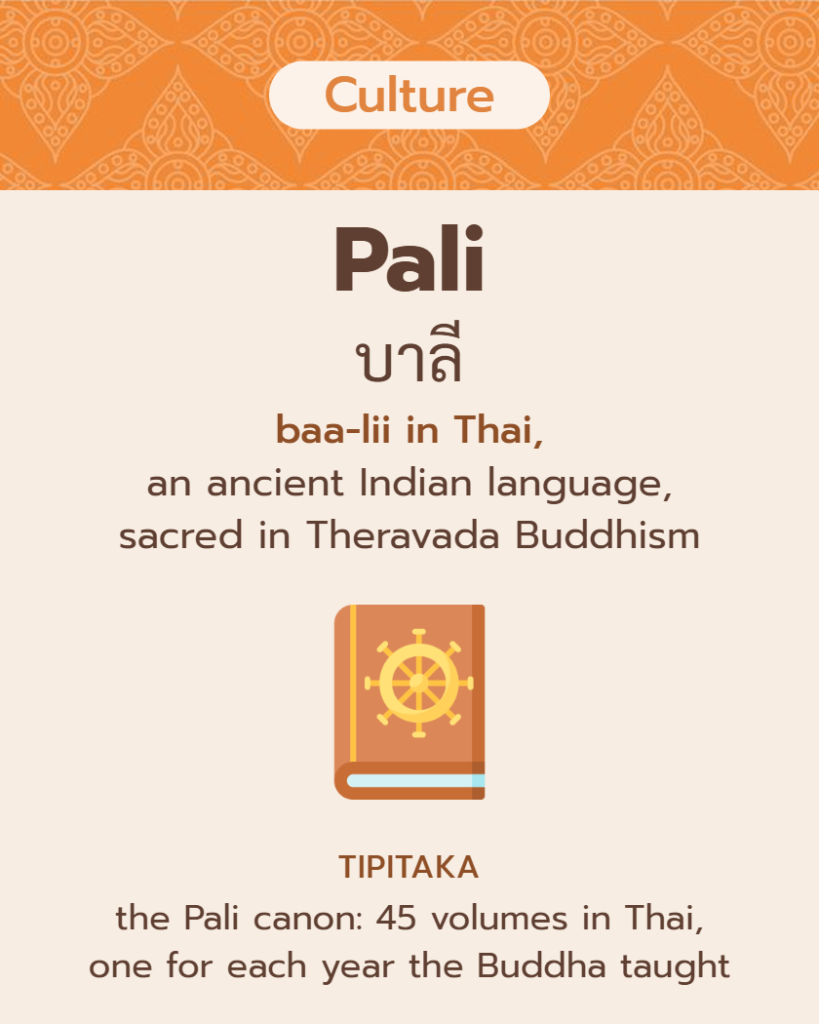
The Pali language, บาลี (baa-lii) in Thai, is the language of the Tipitaka, the scriptures of Theravada Buddhism. It is not anyone’s mother tongue. In Thailand it lives in temples, monastic schools and libraries: monks chant it, study it in a national exam system and print its canon in Thai letters.
What is the Pali language?
Pali is a Middle Indo-Aryan language, a close relative of Sanskrit. Many religious words exist in both: Sanskrit dharma is Pali dhamma, and Thai ธรรม (tham).
The name comes from pāḷi, “line, row”. Early Buddhists used it for the line of original text, as distinct from the commentary that followed it. Only later did it become the name of the language.
The canon itself never calls its language Pali. The commentaries call it Magadhi, the language of the kingdom of Magadha, where the Buddha taught. That is why Thai also calls it ภาษามคธ (phaa-sǎa má-khót). Modern scholars think the Buddha probably spoke a related dialect, not Pali itself.
Thai teachers explain the name differently. They derive บาลี from the Pali verb pāl, “to protect”, and read it as “the language that keeps the Buddha’s words”.
Pali has no script of its own. Each Buddhist country writes it in its own letters.
How Pali reached Thailand
The earliest evidence of the Pali canon in the region comes from inscriptions of the Pyu city-states in Burma, dated to the 5th and 6th centuries.
In the north, Chiang Mai became a centre of Pali learning in the late 15th century. Under King Tilokaraj, the Tipitaka was revised there in 1477, the first such revision on Thai soil.
In 1516-17 the monk Ratanapañña wrote the Jinakalamali, a history of Buddhism, in Pali. His contemporary Sirimaṅgala wrote Pali works in the same city.
After Ayutthaya fell in 1767, many texts were lost. In 1788 King Rama I called a council at Wat Mahathat in Bangkok, where 218 monks and 32 lay scholars spent five months revising the Tipitaka.
From Khom script to Thai letters
For centuries, central Thailand wrote Pali in Khom, a script derived from Khmer. King Mongkut, who spent 27 years as a monk before he became Rama IV, discouraged it because people treated the script itself as holy and magical.
In the 1840s he even invented a new script for Pali, Ariyaka. It never caught on.
The lasting change came under Rama V. A council in 1888 transliterated the canon into Thai letters, and it was printed in 39 volumes. Sources date the printing between 1888 and 1893. Editions since Rama VII have 45 volumes, to match the 45 years the Buddha taught.
Pali written in Thai uses one extra mark, the phinthu ( ฺ ). A dot under a letter makes it a final consonant, so พุทฺโธ is read phút-thoo.
Pali inside the Thai language
Thai script comes from the same Indian tradition as the scripts used for Pali. Of the 44 Thai consonants, 34 descend from the Brahmi script, by way of Grantha and Khmer.
Many Pali words are so ordinary that Thais take them for Thai:
- บาป (bàap) – sin
- บารมี (baa-rá-mii) – perfection
- วินิจฉัย (wí-nít-chǎi) – to judge, to diagnose
- ปฏิวัติ (pà-tì-wát) – revolution
Thai personal names are often built from Pali and Sanskrit. How Thai uses the two languages differently deserves its own article.
Why Pali stayed the language of religion
Theravada Buddhism holds the Pali canon to be the Buddha’s own teaching. A translation can explain it, but only the original wording carries that authority.
Pali also connected the Theravada countries. By 1753, the line of monastic ordination had died out in Sri Lanka. The Thai monk Upali sailed from Ayutthaya to Kandy and ordained Sri Lankan monks.
He also taught them the Pali formulas for the ceremony. The order he founded is still called the Siam Nikaya.
Kings had their own reasons. Revising the canon showed a ruler’s power and virtue, so the councils of 1477 and 1788 and the printed edition of the 1890s were all royal projects.
Chanting kept the sound alive. Every Thai consonant belongs to a tone class, so Pali read in Thai letters picks up Thai tones. This gives Thai chanting its melody.
Pali in Thailand today
Monks study Pali in nine grades, with national exams every year. The top grade is เปรียญธรรม 9 ประโยค (prà-rian-tham kâo prà-yòok). In 2025, 72 monks and novices passed it.
Results are still announced by reading out the names one by one. The King then presents fans of rank to the new graduates at Wat Phra Kaew.
The exams are run from Wat Paknam in Bangkok, whose abbot heads the exam office. The temple’s library holds the Tipitaka in old scripts and in Thai, along with Pali dictionaries and the records of the monastic order.
Laypeople have their own exam track, called บาลีศึกษา (baa-lii-sùk-sǎa), “Pali studies”.
Who shaped Pali in Thailand
- Ratanapañña – Chiang Mai monk, author of the Jinakalamali (1516-17)
- Sirimaṅgala – Pali author in Chiang Mai, early 16th century
- Upali – Ayutthaya monk who restored ordination in Sri Lanka in 1753
- King Rama I – called the 1788 council
- King Mongkut (Rama IV) – reformed monastic study around the Pali canon and wrote Pali chants still used today
- King Rama V – had the canon printed in Thai letters
Can anyone learn Pali?
Yes. Outside Thailand, the Pali Text Society, founded in London in 1881 by T. W. Rhys Davids, publishes the canon in Roman letters, with dictionaries and textbooks for students.
In Thailand, the lay exam track is open to anyone.
References
- Pali – Wikipedia
- บาลี : ภาษาคัมภีร์เถรวาท – มหาวิทยาลัยมหาจุฬาลงกรณราชวิทยาลัย
- Ariyaka script – Wikipedia
- การพิมพ์พระไตรปิฎก – ทรูปลูกปัญญา
- ลำดับของรูปพยัญชนะในภาษาไทย – วารสารสุทธิปริทัศน์
- Thailand’s gift to Sri Lanka: the establishment of the Siam Nikaya – Lorna Dewaraja
- ผลสอบบาลีสนามหลวง 2568 – ไทยรัฐ