

Sawatdee (สวัสดี): The Thai Greeting Invented in the 1930s
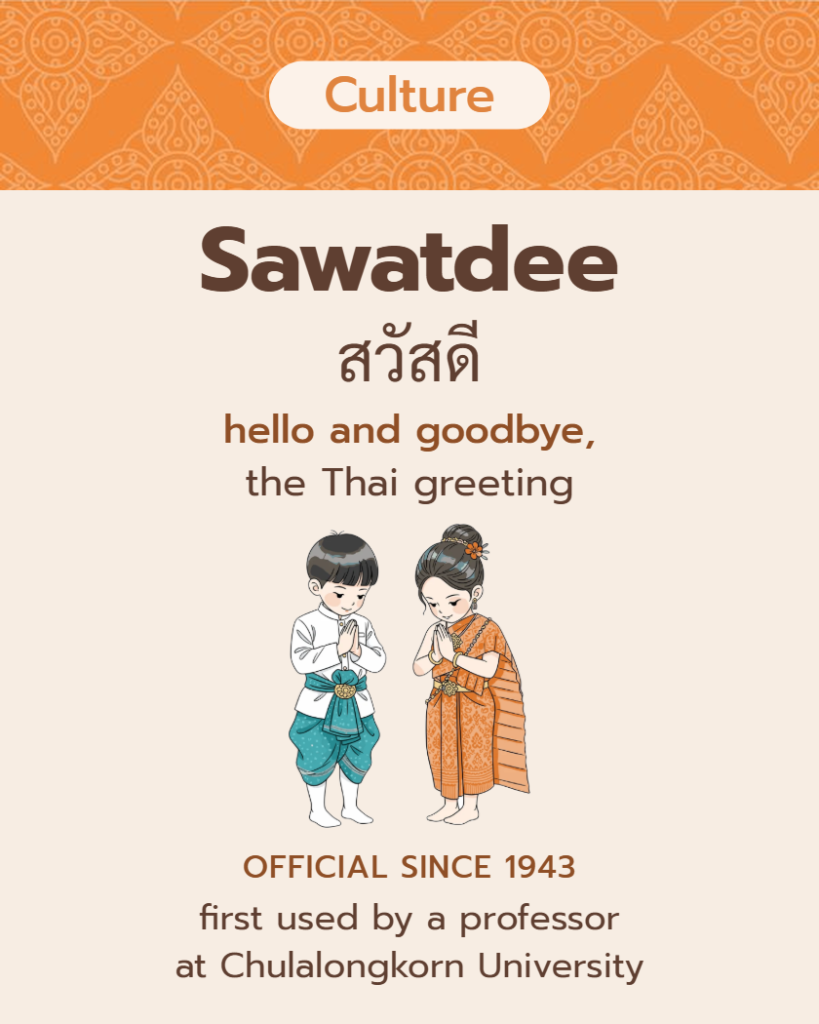
Sawadee (สวัสดี ) is the first Thai word most visitors learn. People hear it at hotel receptions, in taxis, at massage shops and at night markets. It usually comes with the wai, a small bow with the palms pressed together. The greeting seems as old as Thailand itself, but it has been in use for less than a hundred years.
Hello and Goodbye in One Word
Sawadee is how to say hello in Thai, and the same word also means goodbye. Speakers add a polite particle at the end. Men say sawadee krap (สวัสดีครับ ), and women say sawadee ka (สวัสดีค่ะ ). To reply, people say the same word back, with their own particle.
How to Pronounce Sawadee
Sawadee is pronounced sà-wàt-dii and has three syllables. The first two syllables are short and have a low tone. The last syllable is long and has a mid tone. A close English version is sa-wat-DEE.
The t in the middle is unreleased. The tongue stops in the position for t, but no air comes out. To English ears, this t is almost silent, so many visitors hear the word as “sa-wa-dee”.
This is why the word has three spellings in English. Sawatdee follows the Royal Thai General System of Transcription (RTGS), the official system of the Royal Institute, and writes the t that Thais pronounce. Sawasdee follows the Thai letters: the word is written with ส (s), but at the end of a syllable this letter is pronounced as t. The s in sawasdee is therefore never pronounced. Sawadee writes what most foreigners hear.
The polite particles also sound different from their spelling. Krap is often pronounced closer to “kap” in everyday speech. Ka has a falling tone at the end of a statement and a high tone at the end of a question.
A Word Created by a Professor
The greeting was created in the mid-1930s by Phraya Upakit Silapasan, a Thai language expert at Chulalongkorn University. He gave the word to his students as a way to greet their teachers. From the university it spread to the committee that worked on the Thai dictionary and to radio programmes.
He built the greeting on the Sanskrit word svasti, which means “well-being” or “good fortune”. Many formal Thai words come from Sanskrit and Pali, the two classical languages of India. Before the 1930s, svasti appeared in Thai only as a formal opening line in inscriptions. For this reason, the sawasdee meaning is closer to a blessing than to a casual “hi”.
The 1943 Decree
On 22 January 1943, the government of Prime Minister Plaek Phibunsongkhram made sawadee the official Thai greeting. The Propaganda Department, which today is the Public Relations Department, issued the announcement.
The greeting was part of a wider programme to modernise the country. Under Phibun, Siam was renamed Thailand in 1939, the New Year moved from 13 April to 1 January, and the Thai script was simplified. The same government also promoted pad thai as a national dish.
How Thais Greeted Each Other Before
Before sawadee, Thai had no single spoken greeting that worked for everyone. The wai itself was the greeting, and the words people used depended on the situation and on the other person’s status. People asked questions such as “Where are you going?” (ไปไหน , bpai nǎi) or “Have you eaten yet?” (กินข้าวหรือยัง , gin khâao rǔe yang). Both questions are still common in Thailand today.
Sawadee and the Swastika
The word swastika comes from the same Sanskrit root as sawadee. Svastika is made of su (“good”), asti (“it is”) and the suffix -ka. In Sanskrit it means a mark of good luck.
The symbol itself is thousands of years old. It appears on seals from the Indus Valley that date to around 2600 BCE (Before the Common Era), and it is still sacred in Hinduism, Buddhism and Jainism. In Thailand it can be seen on temples and amulets. In 1920, the Nazi Party in Germany adopted the swastika as its emblem, and in the West the symbol has been linked to Nazism ever since.
Every time someone in Thailand says sawadee, they use a greeting from the 1930s that is built on an ancient Sanskrit word for well-being.
References
- Thai PBS: 22 มกราคม 2486 ประกาศใช้ ‘สวัสดี’
- Silpa Wattanatham: คำว่า “สวัสดี” มาจากไหน? ใช้เมื่อไหร่? ใครเริ่ม สวัสดี?
- Thailex: sawatdi (สวัสดี), etymology and history of the Thai greeting
- Rikker Dockum: Etymologist 16, on the origin of สวัสดี sawatdi
- The Thaiger: From ‘Sawadee’ to ‘Pad Thai’. Who was Phibun?
- Wiktionary: swastika