

Ramakien (รามเกียรติ์): The Thai Ramayana
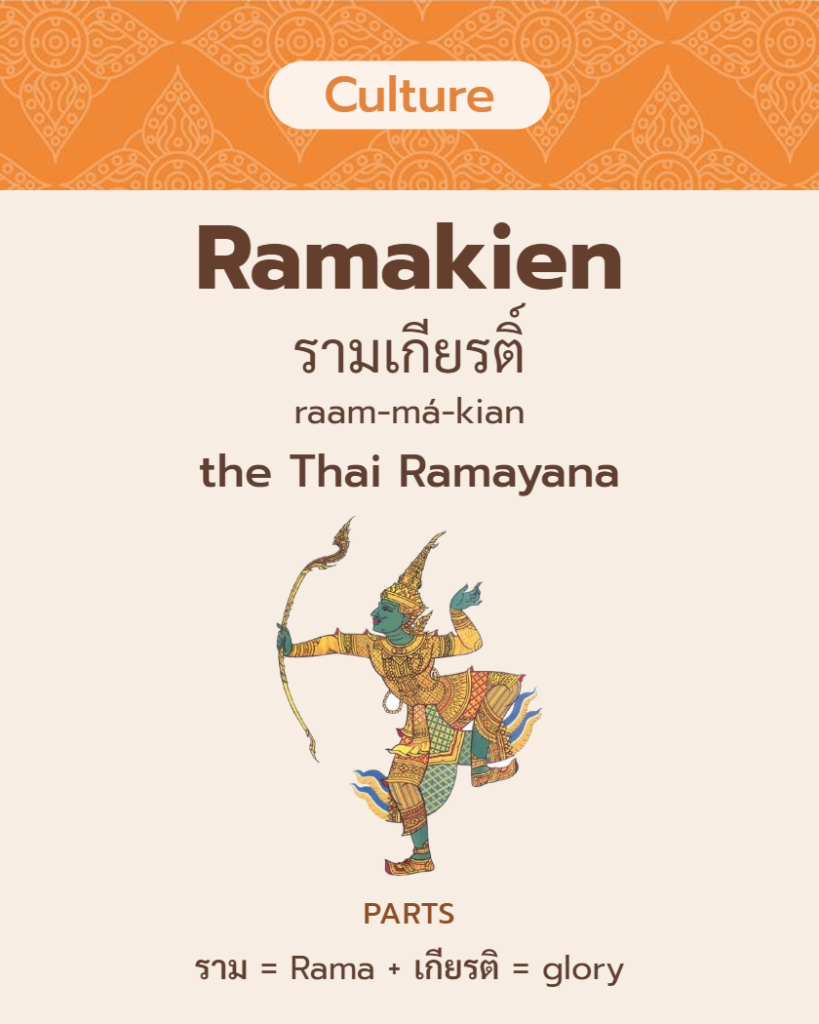
The Ramakien is the Thai version of the Ramayana. The name already shows how it differs.
Ramakien: the name
รามเกียรติ์ (raam-má-kian) is two words:
- ราม (raam) – Rama
- เกียรติ (kian) – glory, honour, from Sanskrit kīrti
Together they mean the glory of Rama.
The original Indian title, Ramayana, is Rāma + ayana, “travel, journey”. In India the story is Rama’s journey. In Thailand it’s the glory of Rama.
What the Ramakien is
It’s the same epic. Thotsakan, the demon king of Lanka, carries off Rama’s wife Sida. Rama wins her back with an army of monkeys led by Hanuman.
Thailand had the story long before Bangkok existed. Most of the old Thai versions burned with Ayutthaya in 1767. The version read today was compiled under Rama I, the first Chakri king, who also wrote parts of it. According to Rama VI, it draws on three Indian sources: Valmiki’s Ramayana, the Vishnu Purana and the Hanuman Nataka.
Ramakien characters
The names come from Sanskrit, and each one has its own Thai version of the story:
- Phra Ram (พระราม ): the hero, an avatar of Narai (Vishnu). He’s painted green.
- Sida (นางสีดา ): his wife, an avatar of Lakshmi. Her name means “furrow”, because she was found in a ploughed field. In the Thai version she’s the daughter of Thotsakan and Queen Montho, the มณโฑ of the letter ฑ. At her birth, Thotsakan’s brother Phiphek foretold that she would destroy the demon family, so Thotsakan put her in a casket and set it adrift. The Indian versions don’t have this.
- Thotsakan (ทศกัณฐ์ ): the demon king of Lanka, Ravana in India, and a yák. His Thai name means “ten necks”, so ten heads. He has twenty arms and keeps his heart in a box, apart from his body.
- Phra Lak (พระลักษมณ์ ): Rama’s brother, born from the naga Ananta, the serpent Narai sleeps on. His body is golden. His name means “the one with good marks”.
- Hanuman (หนุมาน ): the white monkey, Rama’s top soldier. In the Thai version he takes many wives. In the Indian version he’s celibate.
Why Rama I rewrote the Ramakien
Rama I took the throne in 1782 after a coup against Taksin. He was a general, not born to the throne, so he presented himself as the man who restored Ayutthaya. He took Ramathibodi as his throne name, the name of Ayutthaya’s founder, and built Bangkok on the old capital’s plan.
Restoring meant rewriting what had been lost:
- Religion: in 1788 a council corrected the Buddhist scriptures.
- Law: in 1805 the surviving laws became one code, the Three Seals Law.
- Literature: the court’s stories were rewritten, the Ramakien among the first.
The Ramakien also had a practical use. It was staged as dance-drama at the celebrations for the Emerald Buddha and for Wat Phra Kaew, the temple of the new capital.
A Hindu epic in a Buddhist country
Thais call themselves Buddhists, and Buddhism is the umbrella. Under it, three systems sit side by side, each with its own job:
- Buddhism takes care of merit, death and rebirth.
- Brahmanism, the Hindu court tradition that came through Khmer kingship, takes care of the state and of timing. Court Brahmins still officiate at royal rites such as the Ploughing Ceremony, and astrologers fix the auspicious hour. The colour of the day comes from the same astrology.
- The spirits (phi) are older than both. They take care of the house and the land, which is what spirit houses are for.
The Ramakien belongs to the middle layer. Its gods (Narai, Isuan, Indra) are Hindu, and its subject is kingship. That’s why it lives in the palace and on temple walls, not in sermons. It still got a Buddhist frame: in the Thai version, Phra Ram is a bodhisatta, a future Buddha.
Still alive
- The murals: the cloister of Wat Phra Kaew has 178 panels of the Ramakien, first painted in 1783. They’re restored constantly, so some part is always new paint.
- Khon: Rama II adapted the text for khon, the masked court dance. In 2007 Queen Sirikit’s SUPPORT Foundation began staging full khon productions for the public, about once a year. UNESCO listed khon in 2018.
- Everyday life: Hanuman, Thotsakan and the rest live on in amulets, tattoos and films. Most Thais know them without having read a line of the text.
References
- Ramakien – Wikipedia
- Ramayana – Wikipedia
- Rama I – Wikipedia
- นางสีดา and ทศกัณฐ์ – วิกิพีเดีย
- The story on the wall – Bangkok Post
- โขนของมูลนิธิส่งเสริมศิลปาชีพฯ – วารสารศิลปากร