

Ratchaphruek (ราชพฤกษ์) – the royal tree
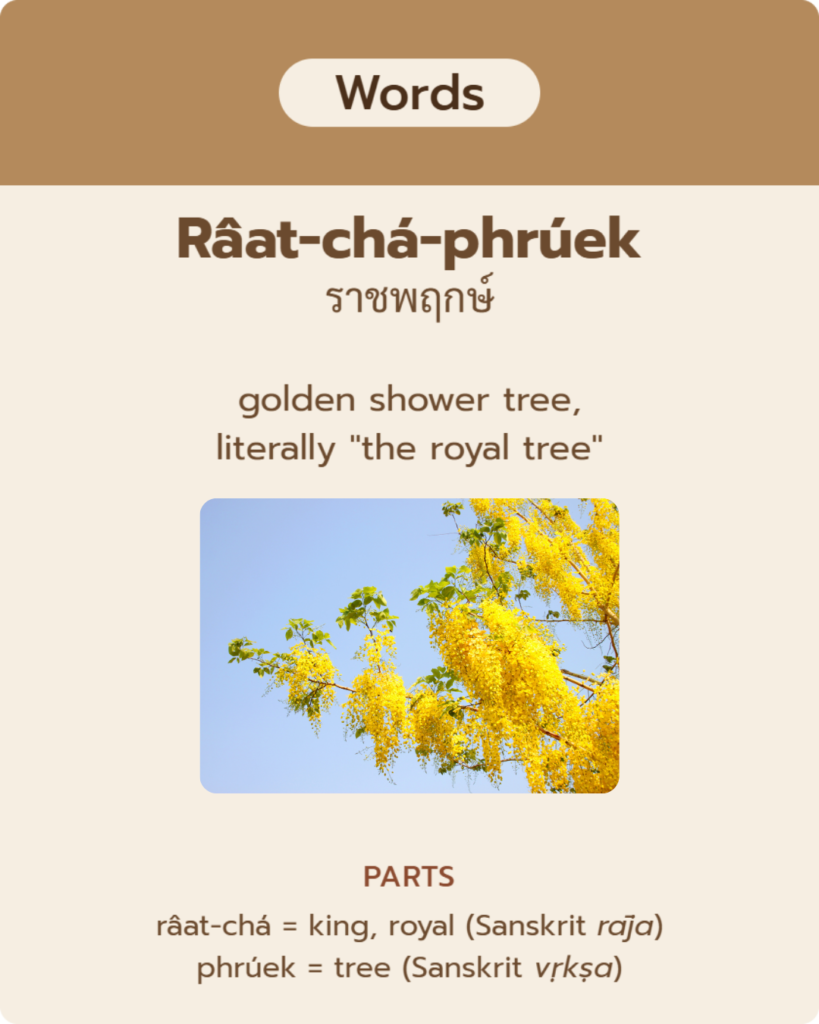
Râat-chá-phrúek (ราชพฤกษ์ ) means golden shower tree.
ORIGIN: Sanskrit rāja + vṛkṣa.
PARTS: râat-chá = king, royal (Sanskrit rāja), phrúek = tree (Sanskrit vṛkṣa).
LITERALLY: the royal tree.
This is Cassia fistula, Thailand’s national tree and national flower, proclaimed in October 2001. The Forest Department’s case for it: it is native, long-lived and grows in every region, and its bright yellow blossoms are the colour of Buddhism and of the King’s birthday. Thais have long held it auspicious — planting one is said to bring honour and dignity to the household, and its wood went into city pillars and house posts.
In everyday speech it’s simply ต้นคูน (dtôn khuun), and in the north ลมแล้ง (lom láeng), “the dry-season wind,” because it flowers when the land is parched. Those blossoms are used as temple offerings and in the Songkran water-blessing rite; when the trees turn yellow, the old people start preparing for the new year.
The same rāja runs through everything royal: ราชการ (râat-chá-gaan, government service, literally “the king’s work”), ราชวงศ์ (râat-chá-wong, dynasty), and the first syllable of Ratchathewi and Ratchaprasong. Phrúek is a high-register word for tree; ordinary speech uses the native ต้นไม้ (dtôn-mái).
Sentence:
ราชพฤกษ์บานสีเหลืองทั้งถนน
Râat-chá-phrúek baan sǐi lěuang tháng thà-nǒn.
The golden shower trees are blooming yellow all along the road.
Sources: