

Rain Tree (จามจุรี): The Symbol of Chula University
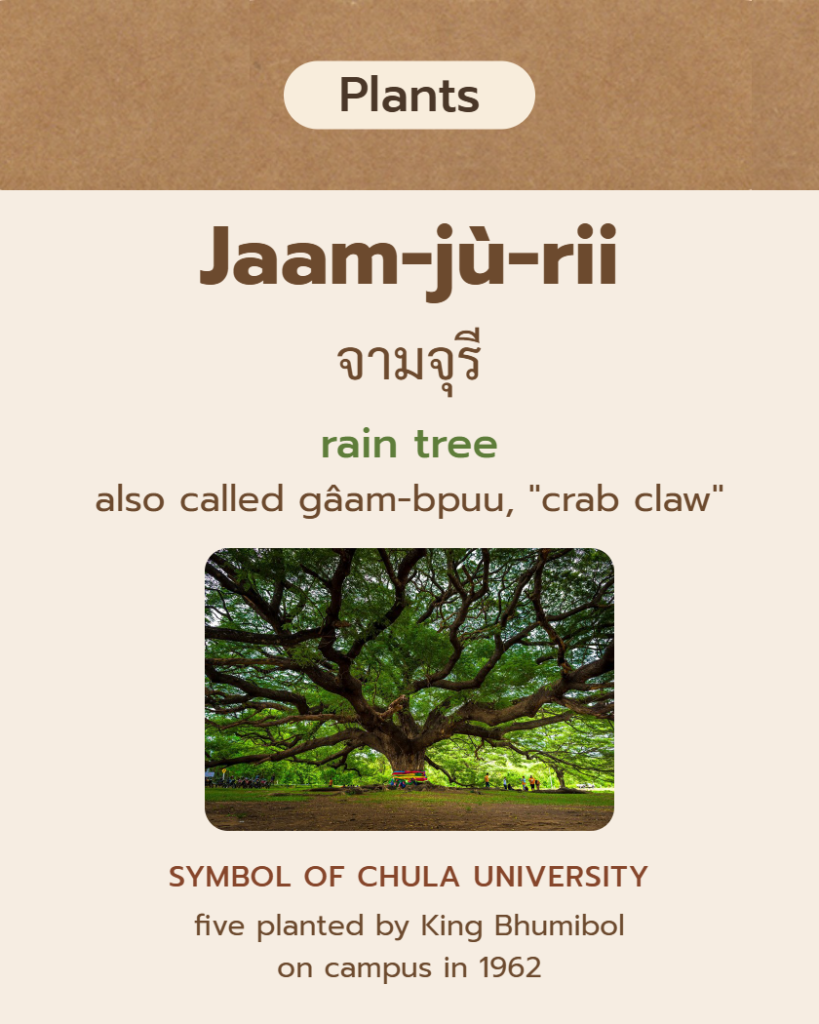
The rain tree (จามจุรี , jaam-jù-rii) is one of the largest shade trees in Thailand. It grows more than 25 metres tall, and its umbrella-shaped crown can spread over 30 metres. In Thai it is also called ก้ามปู (gâam-bpuu, crab claw), and in the north ฉำฉา (chǎm-chǎa).
Where the Rain Tree Comes From
The rain tree, Samanea saman, is not a Thai tree. It is native to Central and South America. According to Silpa Wattanatham, Mr. H. Slade, the first head of Thailand’s Royal Forest Department, brought it from Burma and planted it at the forestry office in Chiang Mai around 1900.
Because it grows fast and gives wide shade, it was soon planted along roads in Bangkok and other provinces. In the north and northeast, farmers grow it as a host for the lac insect, which produces lac resin.
Why It Is Called a Rain Tree
The leaflets of the rain tree fold up in the late afternoon and when the sky darkens before rain. This is probably where the English name comes from. In Malay, the tree is called pukul lima, “five o’clock”, for the same reason.
Symbol of Chula University
Before Chulalongkorn University (จุฬาลงกรณ์มหาวิทยาลัย ) was built, its land in central Bangkok was covered with rain trees, and students studied in their shade. Over the years, many trees died of disease or were cut down for new buildings.
On 15 January 1962, King Bhumibol visited the university and planted five young rain trees, brought from Klai Kangwon Palace in Hua Hin, beside the football field in front of the University Auditorium: three on the right and two on the left. One of the five fell in a storm in 2019.
The university later created a Rain Tree Grove for the 50th anniversary of King Bhumibol’s reign and planted 80 rain trees for its own 80th anniversary. Today the rain tree is one of Chula’s official symbols, together with the Phra Kiao emblem and the colour pink. The university is also where the greeting sawadee was first used.
The Tree and the Student Year
For Chula students, the rain tree follows the academic year. Fresh green leaves at the start of the year stand for new students. Later the tree drops sticky pods and leaves, and the ground under it becomes slippery, a reminder to prepare for exams. Students say that those who walk carefully will not slip, and will pass.
References