

Thai Mango (มะม่วง): Unripe and Ripe
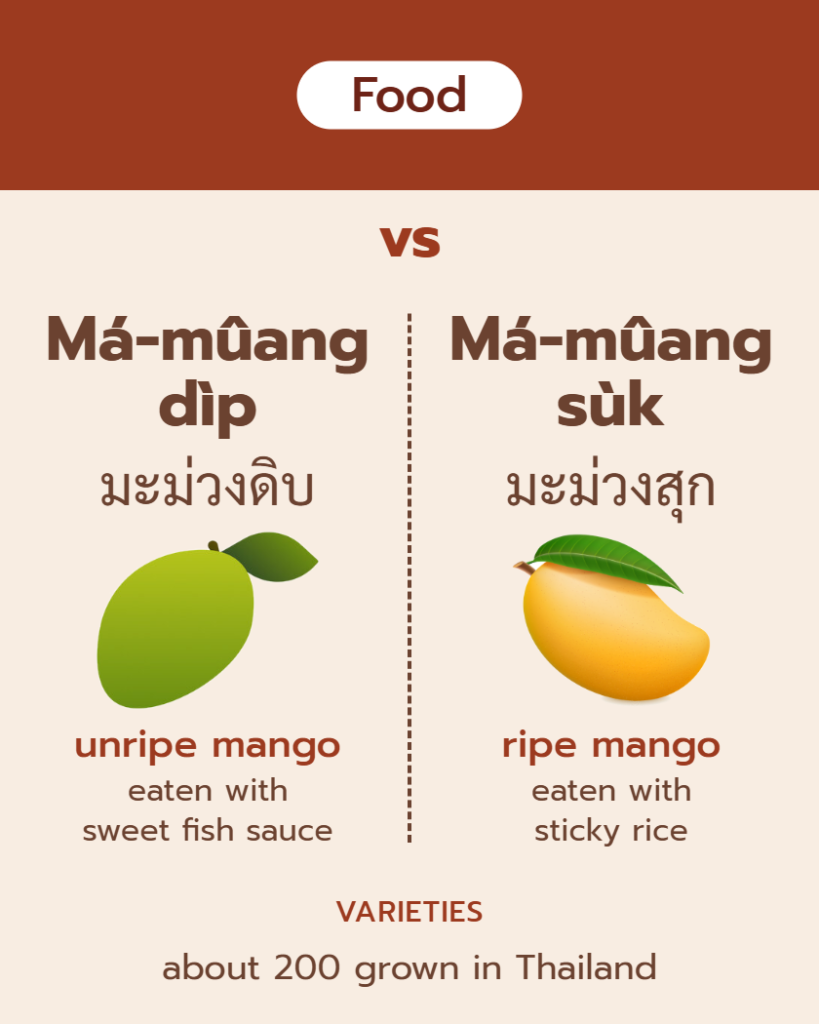
Thai mango, มะม่วง (má-mûang), is eaten in two ways, and Thai has a word for each. มะม่วงดิบ (má-mûang dìp) is the unripe, sour mango, eaten with sweet fish sauce. มะม่วงสุก (má-mûang sùk) is the ripe, sweet mango, eaten with sticky rice.
Thai mango: má-mûang
มะม่วง is a shortened form of หมากม่วง (màak-mûang). หมาก is the old Tai word for fruit. On its own it now means areca nut, but in its short form มะ it begins many fruit names, such as มะพร้าว (coconut), มะละกอ (papaya) and มะนาว (lime). หมากม่วง is an old word. The Ram Khamhaeng inscription of 1292 already notes that there are many หมากม่วง in Sukhothai.
ม่วง on its own is also the Thai word for purple, and the two meanings are connected. In old Thai, ม่วง alone meant mango, and สีม่วง , the colour, is usually explained as “the colour of mango leaves”, after the purplish-red young leaves. The Thai edition of Wiktionary gives two possible explanations: the colour of the young shoots, or the colour of some varieties when ripe. Either way, the colour was probably named after the mango, not the other way round.
The mango is not native to Thailand. It probably came from India, where it has been grown for at least 4,000 years. Thailand is now a large producer: in 2022 it ranked tenth in the world, with about 1.4 million tonnes.
Dìp and sùk: the same words as raw and cooked
ดิบ (dìp) is an old Tai word that means raw, unripe or unprocessed. สุก (sùk) probably comes from Middle Chinese 熟, which means both ripe and cooked. Thai took several kitchen words from Chinese, among them the word for the noodles in pad thai.
Thai uses the same pair for food in the kitchen, so an unripe mango is described with the word for raw meat, and a ripe mango with the word for cooked meat.
In English, an unripe mango is often called a green mango. Thai doesn’t use เขียว (khǐao, green) for it, and colour would be a poor guide anyway, because some varieties keep a green skin after they ripen.
มะม่วงดิบ: unripe mango with sweet fish sauce
Unripe mango is sour and crisp. Thais dip it in น้ำปลาหวาน (náam-plaa-wǎan), sweet fish sauce, which is made by cooking down palm sugar and fish sauce and adding shallots, dried shrimp and chilli. Palm sugar, fish sauce and dried shrimp also go into pad thai. The snack is called มะม่วงน้ำปลาหวาน (má-mûang náam-plaa-wǎan).
Two varieties are known for being eaten unripe:
- มะม่วงเขียวเสวย (má-mûang khǐao-sà-wǒei) means “green, fit for a king”, because เสวย is the royal word for eat. Its flesh is firm and crunchy, and it is often used in salads. It is one of seven Thai varieties that Japan allows in.
- มะม่วงฟ้าลั่น (má-mûang fáa-lân) means “thunderclap”.
มะม่วงสุก: ripe mango with sticky rice
Ripe mango is eaten with sticky rice, a dessert called ข้าวเหนียวมะม่วง (khâao-nǐao má-mûang). The mango season runs from March to May.
Two varieties are known for being eaten ripe:
- มะม่วงน้ำดอกไม้ (má-mûang náam-dòk-mái) means “flower water”. It is the most popular variety for sticky rice because it is sweet and smooth.
- มะม่วงอกร่อง (má-mûang òk-rông) means “grooved chest”. It is harder to find, with a few fruits in January and more in March and April.
How many Thai mango varieties are there?
Sources give different numbers. Kasetsart University says about 200 varieties grow in Thailand, and a 2026 paper from King Mongkut’s University of Technology North Bangkok says more than 100. One reason for the gap is that growers rename trees, so the same imported variety can have one name in Nakhon Ratchasima and another in Nonthaburi.
People have been listing mango varieties for a long time. In 1884, Phraya Si Sunthon Wohan listed the varieties of his day in a poem written in kap yani verse. According to Silpa Wattanatham, some were named after how much people liked the taste, such as แขกขายตึก, “the khaek sold his house”, and สาวรัญจวน, “the lovesick girl”. Another old variety is พราหมณ์ขายเมีย, “the Brahmin sold his wife”. Thai durian varieties also have descriptive names, as the durian card shows.
Thirteen Thai mango varieties now have geographical indication (GI) status. This means each one is registered as a product of a particular place, and together they come from nine provinces.
References
- พันธุ์มะม่วง – เทคโนโลยีชาวบ้าน
- รู้จัก “มะม่วง” พันธุ์โบราณ นาม “พราหมณ์ขายเมีย” – ศิลปวัฒนธรรม
- ม่วง – Wiktionary
- Why mango sticky rice is one of Thailand’s most beloved summer dishes – CNN
- Mango in Thailand – JIRCAS
- Mango in Thailand, p.104 – Kasetsart University
- Thailand highlights top five GI mangoes by market value – FreshPlaza