

Hang nok yung farang (หางนกยูงฝรั่ง) — the Western peacock’s tail
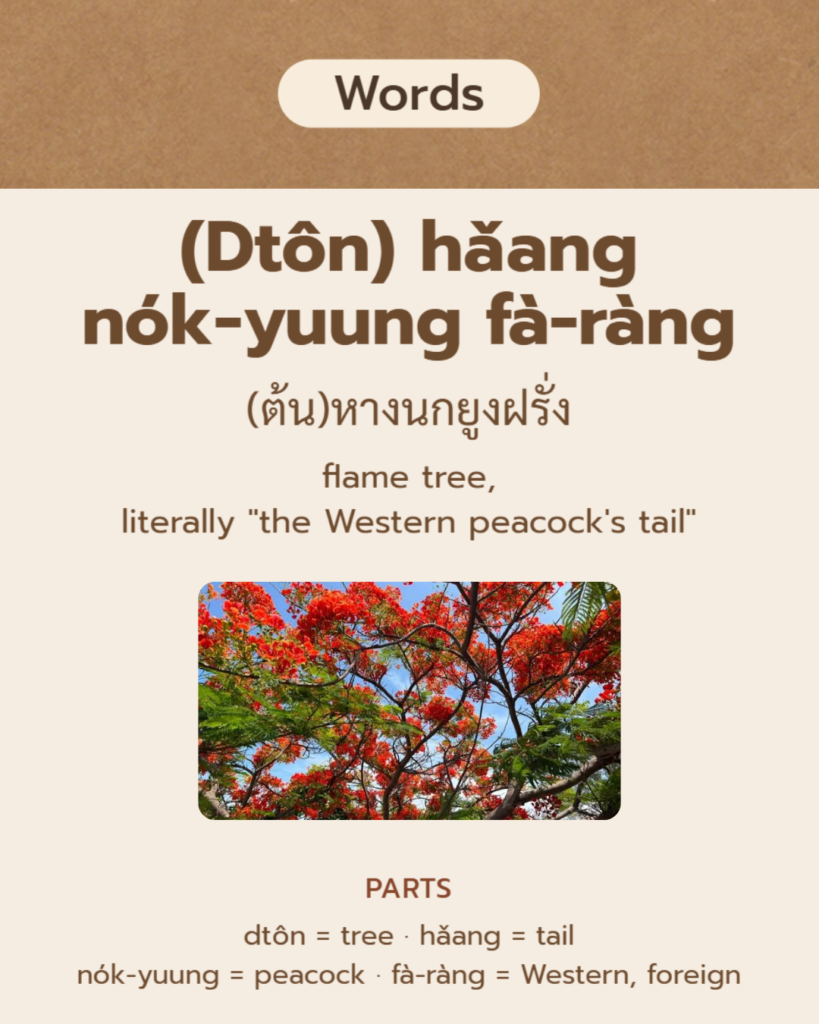
(Dtôn) hǎang-nók-yuung fà-ràng (ต้นหางนกยูงฝรั่ง ) means flame tree.
PARTS: dtôn (ต้น) = tree, plant; hǎang (หาง) = tail; nók-yuung (นกยูง) = peacock; fà-ràng (ฝรั่ง) = Western, foreign.
LITERALLY: the Western peacock’s tail.
SCIENTIFIC NAME: Delonix regia.
The Royal Institute Dictionary describes it as a large tree with no thorns on the trunk or branches. Its flowers are red or orange-red, it blooms once a year, and it drops its leaves while it flowers. In English it’s called flame tree, royal poinciana or flamboyant. It comes from the dry forests of Madagascar and has since been planted throughout the tropics, Thailand included.
The fà-ràng tells you there’s another one. Plain หางนกยูง (hǎang-nók-yuung), also called หางนกยูงไทย (hǎang-nók-yuung thai, “Thai peacock’s tail”), is a different plant: a thorny shrub, Caesalpinia pulcherrima, with red, yellow or pink flowers. When a big foreign tree arrived that looked like it, Thai named it the “Western” version.
That’s a pattern in Thai. The dictionary notes that ฝรั่ง (fà-ràng) is added to the names of imported things that resemble Thai ones. The best-known example is มันฝรั่ง (man fà-ràng), “Western tuber,” which is the potato. On its own, ฝรั่ง means a Westerner, and it’s also the Thai word for guava.
English mixes these two plants up as well: “peacock flower” is a name used for both of them.
Sentence:
ต้นหางนกยูงฝรั่งออกดอกสีแดงทั้งต้น
Dtôn hǎang-nók-yuung fà-ràng òk dòk sǐi daeng tháng dtôn.
The flame tree is covered in red flowers.