

Hua Hin (หัวหิน): The Meaning of the Name
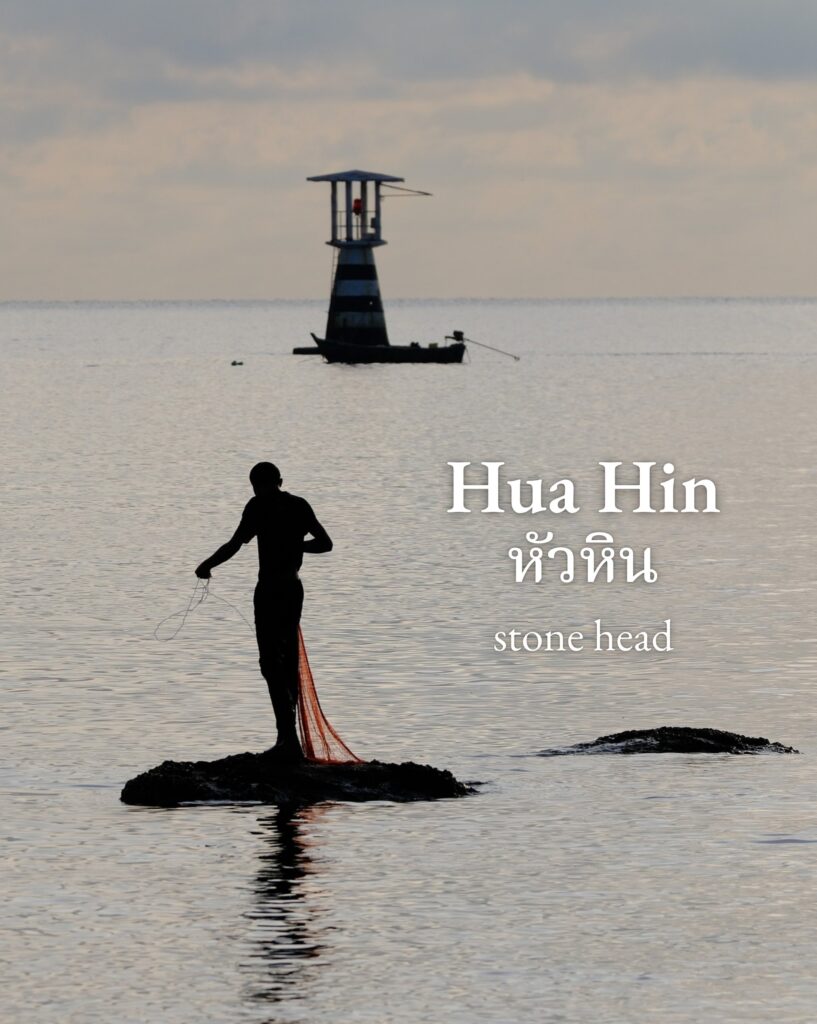
Hua Hin (หัวหิน ) is a beach town on the Gulf of Thailand, about 200 km south of Bangkok. Its name is two words, both with a rising tone:
- หัว (hǔa) – head
- หิน (hǐn) – stone
So Hua Hin is “stone head”.
Where the name comes from
In 1834, drought hit the farms of Phetchaburi, and farmers moved south to a small fishing village by the sea. They called it Samore Riang, “rows of rocks”, after the rocks along its beach.
The first royal to build a palace there was Prince Naresra (กรมพระนเรศวรฤทธิ์). He named the beach next to his palace Hua Hin, after the same rocks. By 1911, it was the town’s official name.
How a fishing village became a resort
The southern railway reached Hua Hin in 1911. Prince Purachatra, head of the State Railways, then built the Railway Hotel by the beach. It took its first guests in October 1922, together with a nine-hole golf course.
The Bangkok elite followed the trains. King Prajadhipok built a summer palace there and called it ไกลกังวล (klai kang-won), “far from worries”. Klai Kangwon Palace opened in 1929.
The king on holiday
On 24 June 1932, King Prajadhipok was at Klai Kangwon. In Bangkok, the People’s Party seized power. The king got the news in Hua Hin, reportedly while playing golf. He accepted a constitution, and Thailand’s absolute monarchy ended while its king was at the beach.
The People’s Party went on to run the country for the next 15 years, including the 1942 spelling reform.
What Hua Hin is famous for
- The beach, with the rocks that gave the town its name.
- Hua Hin railway station: a wooden station with a royal waiting room. The waiting room was first built at Sanam Chandra Palace in Nakhon Pathom and later moved here.
- The Railway Hotel: now the Centara Grand Hua Hin. In the film The Killing Fields (1984), it played a hotel in Phnom Penh.
- Klai Kangwon Palace: still a royal residence. King Bhumibol lived there full-time from 2004 to 2006.
References
- Hua Hin district – Wikipedia
- The Railway Hotel, Hua Hin – Wikipedia
- Klai Kangwon: A Royal Retreat – Google Arts & Culture
- June 24, 1932: The path towards Thai democracy – The Nation
- The Origins of Hua Hin Town – Your Thai Guide