

ษ (So Ruesi): The Thai Letter of the Rishi, the Hermit
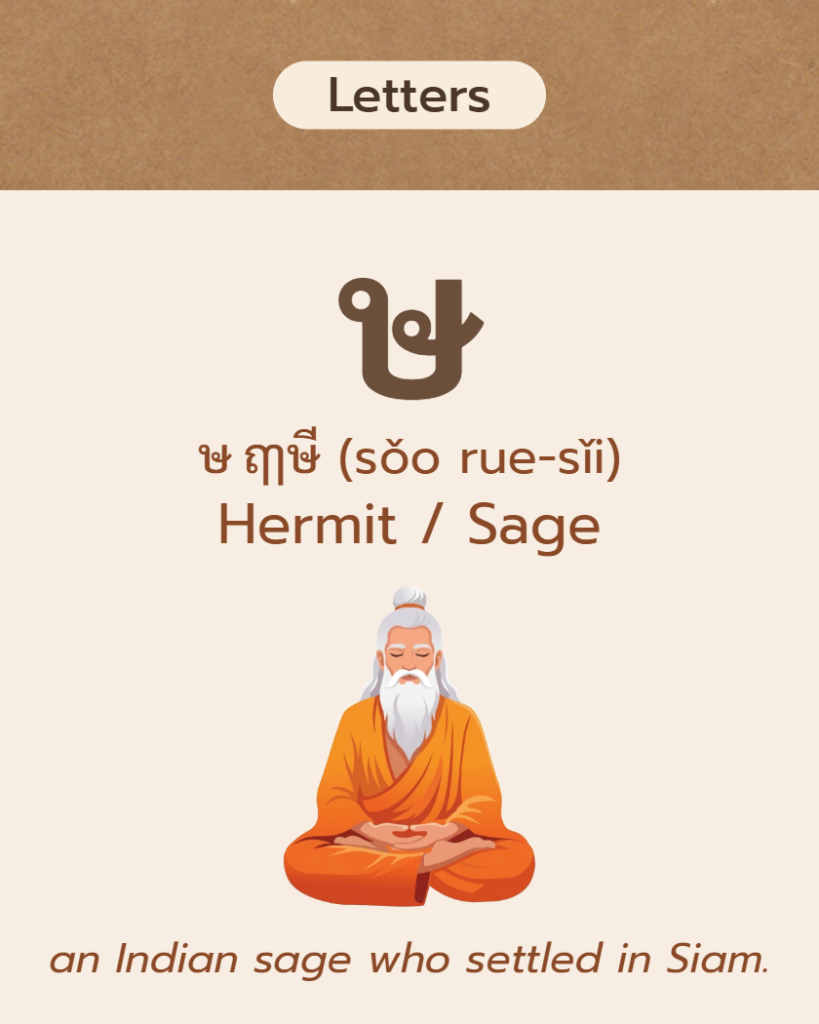
ษ ฤๅษี (sǒo rue-sǐi) is the 39th letter of the Thai alphabet. Like every Thai consonant it has a name-word, and its word is ฤๅษี : a rishi, a hermit sage of the forest.
How ษ entered the Thai alphabet
Thai writing came from India by way of the Khmer, and it brought letters made for Sanskrit. Sanskrit had three different s-sounds, and Thai kept a letter for each: ศ, ษ and ส.
Thai speakers never kept the difference. All three are read s, and at the end of a word ษ is read t. ษ stands for the Sanskrit ṣ, so it lives in Sanskrit loanwords: ภาษา , “language”, and อังกฤษ , “English”. The Thai name for the English language, ภาษาอังกฤษ , has it twice.
When the 1942 spelling reform cut the duplicate letters, ษ was on the list, and so was the vowel ฤๅ. The letter’s own name-word lost two of its letters. Both came back in 1944.
How the word came in: two doors
Like ฐ, the word reached Thai twice, from two Indian languages:
- From Sanskrit ṛṣi came ฤๅษี (rue-sǐi), the everyday Thai word for a hermit.
- From Pali, the language of Theravada Buddhist scripture, came isi, written อิสิ in Thai, the form used in Buddhist texts.
Why a hermit matters in a Buddhist country
The rishi is older than Buddhism, and Buddhism kept him:
- The first sermon: the Buddha gave his first sermon in a park called Isipatana, Pali for “where the sages came down”. Today it’s Sarnath, in India.
- The teacher of the arts: in Thailand the hermit is honoured as the source of the classical arts. When khon dancers, who perform the masked dance drama, honour their teachers, the head teacher wears the hermit’s mask.
- Healing: Thai massage and traditional medicine honour the hermits in their teacher ceremonies too.
The best place to see them is Wat Pho. In 1836 King Rama III ordered 80 statues of hermits in stretching poses, made of a zinc and tin alloy. The practice they show is ฤๅษีดัดตน (rue-sǐi dàt ton), “the hermit stretching himself”, each pose a stretch for a particular ailment. Only 24 of the original statues survive. The hermit’s path goes through samadhi, the steady mind.
Rishi meaning and its relatives
In Sanskrit, ṛṣi meant a singer of sacred hymns, a sage. Its origin is still debated: Wiktionary links it to a root meaning “to flow, pour”, while an old Indian commentator linked it to “to see”, which fits the rishi as a seer.
From India the word spread in every direction:
- Persian side: its close sibling in Avestan, the language of the Zoroastrian scriptures, is ərəšiš, “seer”, just as Thai สถาน has its sibling in Persian -stan.
- India: rishi in Hindi, Bengali, Tamil and Nepali. English borrowed it as rishi, and Maharishi means “great rishi”.
- Southeast Asia, through Pali isi: Burmese i.si, Khmer ʼisəy, Sinhala isi, Thai อิสิ.
- Indonesia: resi, “sage”, in Javanese, Balinese, Malay and Indonesian.
- Lao: lư̄ sī, the neighbour of Thai ฤๅษี.
- Europe: the Roma, who left India a thousand years ago, carried it with them. In Romani, rashaj means a priest.
So a hermit in Thailand, a sage in Indonesia and a priest among the Roma all go back to the same Sanskrit word.
Thai children learn ษ with a hermit in it, just as they learn ย with a giant.
- Wikipedia, “Thai script”: the letter’s origin and the three Sanskrit s-letters. https://en.wikipedia.org/wiki/Thai_script
- Wiktionary, “ऋषि (ṛṣi)”: the etymology and the word’s descendants across languages. https://en.wiktionary.org/wiki/ऋषि
- Wiktionary, “raśaj”: the Romani word for priest. https://en.wiktionary.org/wiki/raśaj
- Wikipedia, “Isipatana”: the place of the first sermon. https://en.wikipedia.org/wiki/Isipatana
- Bangkok Post, “80 new sculptures to promote art of traditional Thai healing”: the Wat Pho hermit statues. https://www.bangkokpost.com/thailand/general/1124909/80-new-sculptures-to-promote-art-of-traditional-thai-healing