Lumpini Park (สวนลุมพินี)
The favorite spot of tourists and Thais alike has always been the one and only Lumpini Park. And not without reason. Cozy, well-kept, conveniently placed by BTS Sala Daeng and MRT Silom and Lumphini, big enough for a proper walk yet compact, it makes a stay in Bangkok bearable – and in the mornings even pleasant. And on top of everything else, it keeps the feeling of bygone days, gone for good.

And I have a personal attachment to it. When I moved to Thailand I settled in Hua Hin, but work kept bringing us to the capital. No matter how many rentals we tried, we always came back to the same cozy lane by Silom Complex, five minutes on foot from Lumpini. And every evening I walked to the park. Pushed through the Silom crowd, dived into the MRT underpass and surfaced in a green oasis. And even in the evening, with hundreds of runners circling the park and the dance lovers moving in formation to loud music, I somehow found serenity in it.
Lumpini Park in the morning
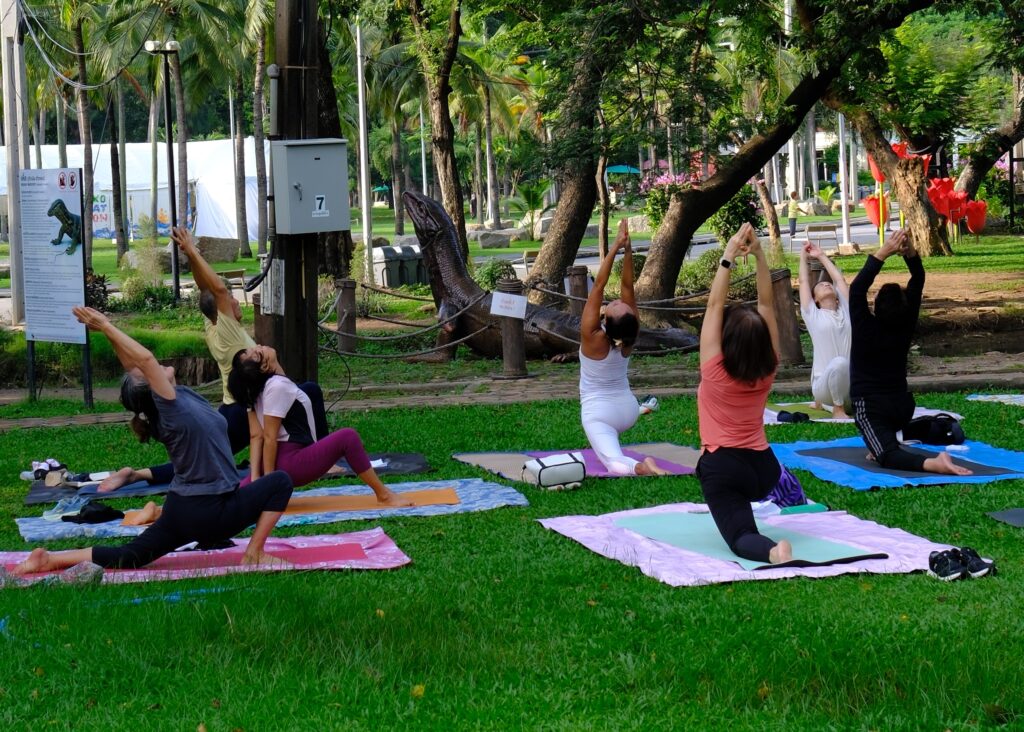
Today, though, we will walk through Suan Lum (as the locals call it) in the morning and get to know its residents a little better. We have rented an apartment in another district, by BTS National Stadium – a couple of stops on the BTS – and I prefer to come to the park early. Before the crowd, the runners, the dancers and the energy of the evening. To see the morning light dancing on the pond, people and cats doing tai chi, the duck boats resting and a new day beginning.

But first, some history.
A short history of Lumpini Park
The land was once Thung Sala Daeng, a royal field on what was then the edge of the city. The field took its name from a railway halt of the 1890s whose building was painted red – sala daeng, the red pavilion – and the BTS station you arrive at today takes its name from the field. In 1925 King Rama VI gave the land to the nation for a great trade fair of Siamese goods, and planned a public park to follow – the first in Bangkok – named Lumphini, after Lumbini, the Buddha’s birthplace in Nepal. He died that same year.

The park took shape over the years that followed, and in 1942 his bronze statue was unveiled at the Rama IV gate. The sculptor was Corrado Feroci, an Italian who had come to Siam to cast monuments and stayed to found its first school of fine arts, taking the name Silpa Bhirasri; Thais call him the father of modern Thai art. During the war the Japanese army camped in the park. Today it is, above all, the city’s lungs and its common room. The ponds are man-made, dug when the park was laid out, and the big rain trees along the paths are nearly as old as the park itself. The water monitors came on their own – no one planted them – and have thrived here ever since. In 2025 the park turned a hundred.
Morning at the pond
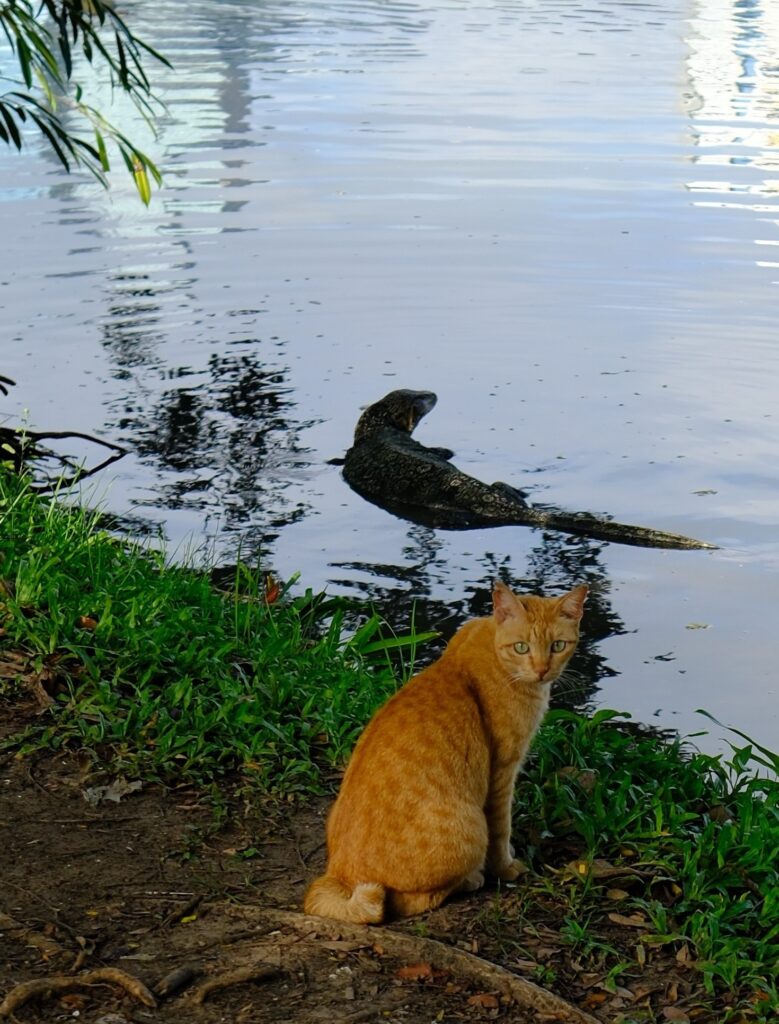
Now, so informed, let’s walk the park. We start at the pond. Water monitors swim here unhurriedly and take their sun baths. The water reflects the buildings rising over the park and blurs their outlines.

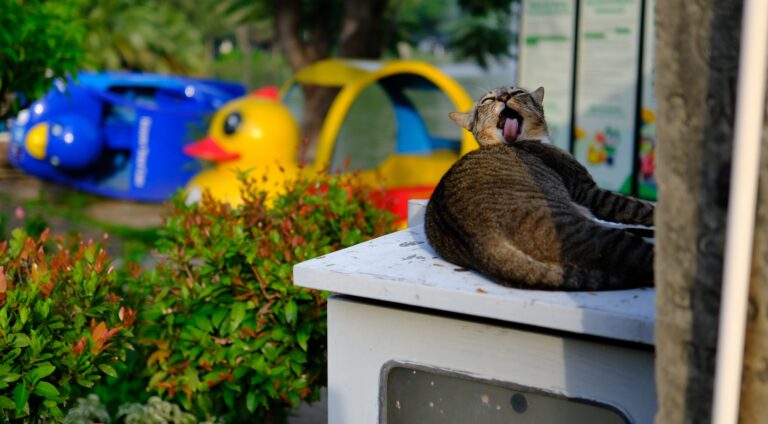
The first runners are already out on the paths, but it is not crowded yet. In the flowerbeds, here and there, cats recline and lazily watch the goings-on. They are the local deities, and they know it. I cannot pass up frames like these, and for a while I dissolve into this feline paradise.

The monitor lizards of Lumpini Park
But the cats have rivals – the water monitors. They even have a statue, yes, really. They compete with the cats for attention, and who wins that contest is anyone’s guess. But that Lumpini has a cult of the water monitor – that is a fact. And here are the cult’s followers, greeting their guru and charging up on morning energy.
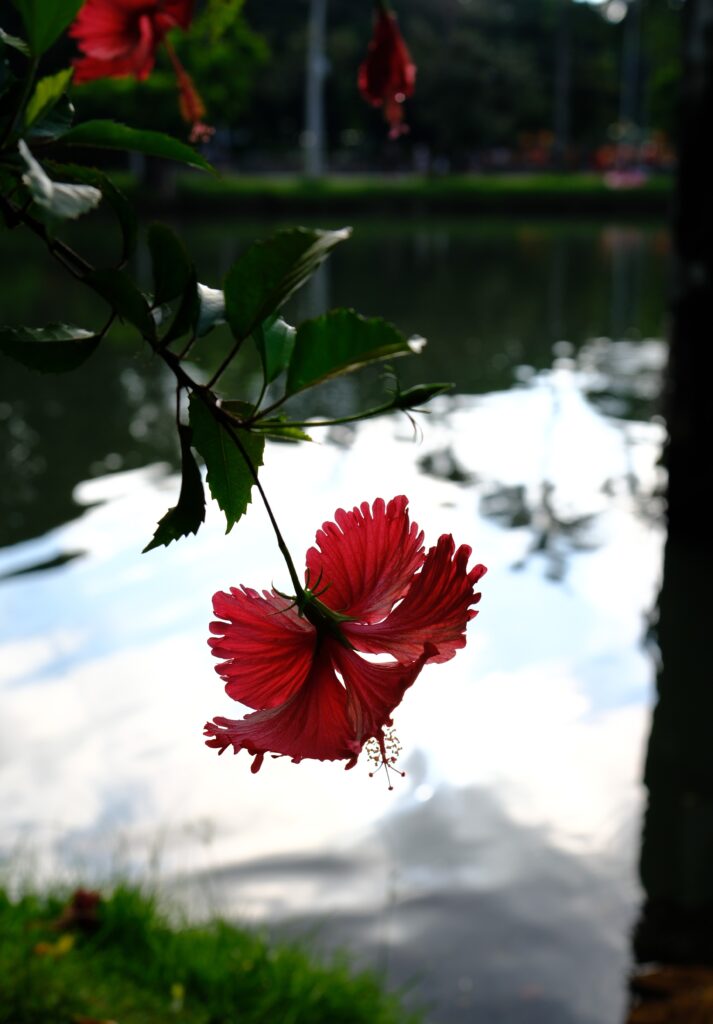
Meanwhile the flowers are reflected in the mirror of the pond and demand no worship at all. Self-sufficient.
In general, the park has a group for almost any interest. In a small pavilion, for example, the singers gather. It is 6:30 in the morning and they are already in full voice, singing in Thai, and clearly enjoying it.
And at some point a feeling of grace comes over me. From the unhurriedness, the soft morning light, the weave of sounds. And from the presence of big old trees that have seen a great deal in their time. I walk, photograph, and simply soak up this morning.

The anthem at eight
Meanwhile the loudspeaker comes on. Eight in the morning – time for the national anthem. The park freezes for a minute. I stop too. With gratitude to this country.
The anthem sung, the park starts moving again. A new day flares up.