

Bua Loy (ขนมบัวลอย): Thai Rice Balls in Coconut Milk
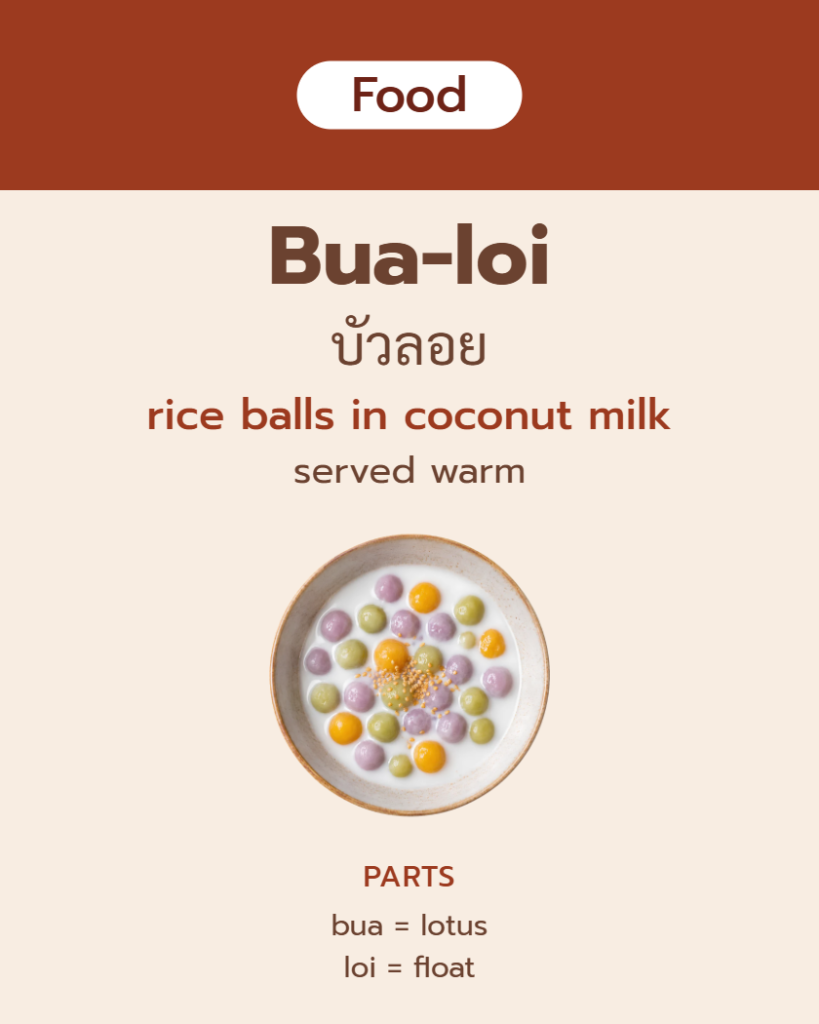
บัวลอย (bua loi) is a Thai dessert of small glutinous rice balls cooked in coconut milk with sugar and a little salt. It is usually served warm. In English the name is most often spelled bua loy, and it is also called ขนมบัวลอย (khà-nǒm bua loi), where ขนม means “sweet” or “dessert”.
What Bua Loy Means
The name has two parts:
- บัว (bua) means “lotus”.
- ลอย (loi) means “float”.
The dessert is named for how it looks: small round balls floating in white coconut milk, like lotus flowers on a pond. The balls also float when they are cooked. Thai recipes say to boil them and lift them out once they rise to the surface.
How Bua Loy Is Made
The dough is glutinous rice flour mixed with water, rolled into balls about one centimetre wide. The coconut milk is simmered with sugar and salt, and often scented with pandan leaves.
The colours of the balls come from plants:
- Green from pandan leaves
- Blue from butterfly pea flowers
- Yellow from pumpkin
- Pink and red from beetroot
- Purple from taro
Kinds of Bua Loy
- บัวลอยไข่หวาน (bua loi khài wǎan) is served with a sweet poached egg.
- บัวลอยไข่เค็ม (bua loi khài khem) is served with a salted egg.
- บัวลอยเผือก (bua loi phʉ̀ak) is made with taro.
Many shops also add steamed taro, candied pumpkin, boiled corn or young coconut.
Bua Loy in the Cold Season
In the past, bua loy was sold mainly in the cold season and eaten hot to warm the body. Today it is sold all year.
Bua Loy at the Winter Solstice Festival
Chinese-Thai families make bua loy for เทศกาลตังโจ่ย (Dongzhi), the winter solstice festival, which falls on 21 or 22 December. It is also known as ตังจี๋ , and in Thai the festival is often called เทศกาลไหว้ขนมบัวลอย, “the festival of offering bua loy”. In Chinese-Thai homes, the dessert is also called ขนมอี๋ .
Families offer bua loy to heaven and earth and to the household spirits. They give thanks that the family got through the past year and ask for protection in the year ahead. The round shape stands for family unity. For the festival, the balls are usually coloured pink and white.
In China, the winter solstice served as the New Year from the Zhou dynasty, making it the oldest Chinese New Year festival.